
Identification
Baby Copperhead Identification: The Yellow Tail Tip and Other Field Marks
Baby copperhead identification made simple. Spot the yellow-green tail tip, hourglass bands, and head shape, and learn why juveniles are not more dangerous.
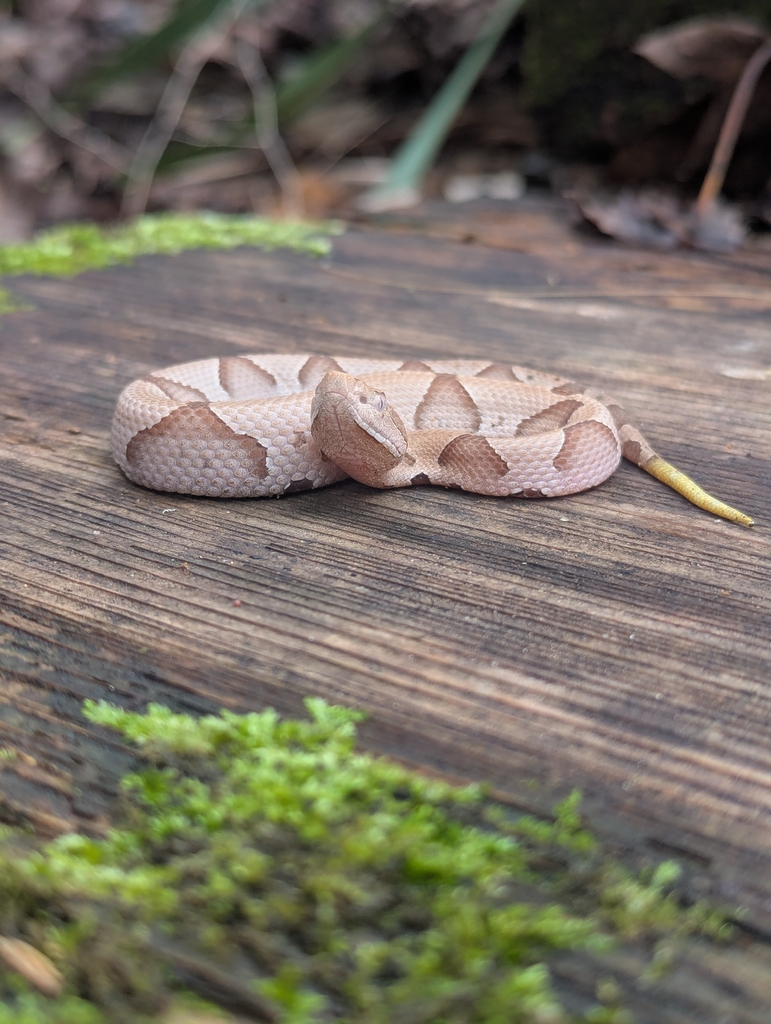
A juvenile copperhead carries one feature that adults lose: a bright yellow to greenish tail tip. Combined with the species' hourglass crossbands and a broad, pit-viper head, it makes baby copperheads identifiable with a little care. Because copperheads are born live and fully venomous, people meet small ones in yards and gardens through late summer, which is also when a stubborn myth resurfaces about baby snakes being more dangerous than adults. Let us cover the real field marks first, then put that myth to rest.
The yellow tail tip
Newborn and juvenile copperheads have a sulfur-yellow or yellow-green tip on the last inch or so of the tail. The young snake wiggles this colorful tail to lure frogs, lizards, and insects within striking range, a behavior called caudal luring. The bright tip fades to brown as the snake matures, usually within the first year or two, so it is a sign of a young copperhead specifically. A few harmless juveniles can show pale tails too, so confirm the tail tip alongside the body pattern rather than relying on it alone.
Hourglass crossbands
Baby copperheads wear the same pattern as adults, just smaller and often more vivid. Dark chestnut crossbands sit on a pinkish to gray-tan background, and each band is wide on the sides and pinched narrow across the spine, forming an hourglass or dumbbell shape when viewed from above. Many harmless look-alikes have blotches that are widest on the back rather than the sides, so the direction of the pinch is a key tell. The hourglass shape, narrow over the spine, is the copperhead signature.
Head and eyes
Like all U.S. pit vipers, copperheads have a broad, triangular head clearly wider than the neck, vertical cat-like pupils, and a heat-sensing pit between the eye and the nostril. Even small juveniles show the blocky head. You should never get close enough to examine a snake's pupils on a live animal, so use head and eye details to confirm an ID from a clear photo taken at a safe distance.
The "baby snakes are more dangerous" myth
You have probably heard that baby venomous snakes are more dangerous because they cannot control their venom and dump it all in one bite. It is not true. Larger adult snakes have far bigger venom glands and deliver much greater volumes of venom, and they have longer fangs and greater reach. A few facts to set the record straight:
- Adult copperheads carry and inject more venom than juveniles, simply because of size.
- Both young and adult snakes can deliver a dry bite with little or no venom, and both can deliver a full one.
- Any copperhead bite warrants medical evaluation, but a juvenile is not inherently worse than an adult.
For the full breakdown, see our explainer on whether baby snakes are more dangerous and the guide to baby snakes and eggs.
Range and where you find young copperheads
Copperheads live across much of the eastern and central United States, and juveniles turn up near wood piles, leaf litter, mulch beds, and stone walls in late summer and early fall, which is when the year's litters disperse. Their camouflage is excellent against dead leaves, so a small copperhead can sit motionless and unnoticed until someone is close. Location tells you which species are possible, not which one you are looking at, so pair it with the field marks above. Check what lives in your county on our state and county pages, and keep yards less inviting by reducing the cover and rodent habitat that draw snakes in, as covered in our guide to keeping snakes away.
Confirm it without getting close
Read the full profile for the eastern copperhead, see the country's other venomous snakes, or upload a photo to our identification tool. You can also test your eye with the snake ID quiz.
A baby copperhead is venomous from birth, so treat it with the same respect you would give an adult: do not handle it, do not try to move or kill it, and give it room to leave. Naming the snake is never required to stay safe from it.