
Identification
Garter Snake vs. Ribbon Snake: Telling the Striped Cousins Apart
A garter snake vs ribbon snake guide. Both are striped and harmless, but the ribbon snake is slimmer with a longer tail and different stripe placement.

Garter snakes and ribbon snakes are close relatives, both in the genus Thamnophis, and both are slender, striped, and completely harmless. They are among the most common snakes people see in yards, gardens, and along water across North America. Because they share that striped look they get mixed up constantly. Neither one is dangerous, so this is a fun identification rather than a safety call, and a few clues sort them out.
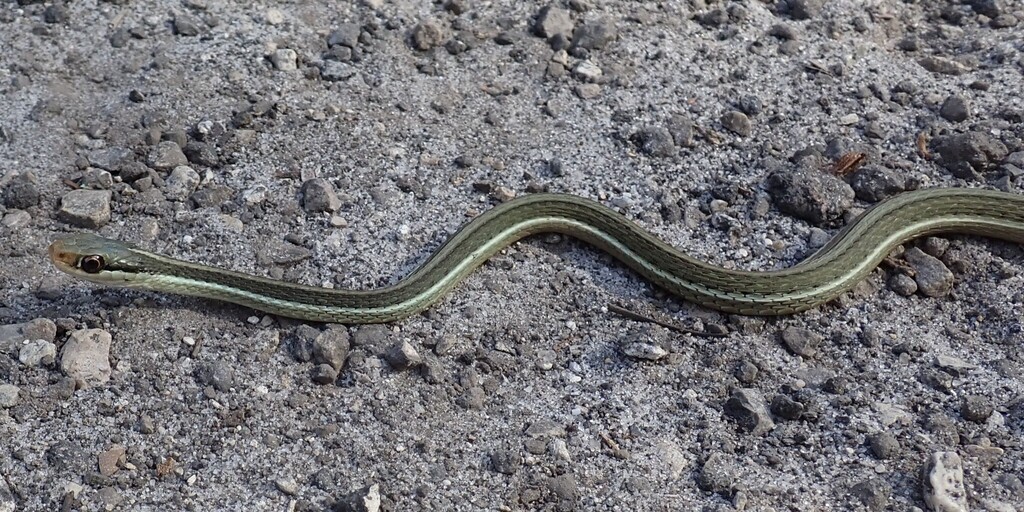
Build: stocky versus slim
The quickest impression is body shape. Garter snakes are relatively stout and thick for their length, with a sturdy, working build. Ribbon snakes are noticeably more slender and graceful, with a thin body that looks almost whip-like. Side by side, the ribbon snake reads as the lean, elegant cousin and the garter snake as the chunkier one.
Tail length is a key tell
One of the most reliable differences is tail length. The ribbon snake has a very long tail, often about a third of its total length, while the garter snake's tail is shorter relative to its body. If the snake looks like it is mostly a long, tapering tail behind the vent, that points strongly to a ribbon snake.
Stripe position and clarity
Both snakes have three light stripes running down the body, but the placement differs. On a ribbon snake the side stripes sit higher, on the third and fourth scale rows, and the stripes are usually clean, bright, and sharply edged against a darker body. Garter snakes are more variable: their stripes can be duller, broken, or overlaid with a checkered pattern, and the side stripes sit lower on the body. A crisp, high, well-defined stripe leans ribbon snake.
Lips, eyes, and head
Look at the face from a clear photo. Ribbon snakes typically have unmarked, bright white or yellowish lip scales and often a distinct light spot in front of the eye, giving a clean-faced look. Garter snakes frequently show dark vertical bars or smudges between the lip scales. The ribbon snake's head is also narrow and barely wider than its slim neck, matching its overall delicate build.
Habitat and behavior
Ribbon snakes stick close to water, the edges of ponds, marshes, and slow streams, where they hunt frogs, tadpoles, and small fish, and they are fast and flighty, often darting across the surface when startled. Garter snakes are far more general: you will find them in gardens, fields, woodland edges, and yards well away from water, eating earthworms, slugs, amphibians, and more. Where you find the snake is a useful hint.
Quick comparison
From a short distance or a clear photo, run through these:
- Build: stocky and thick suggests garter; slim and whip-like suggests ribbon.
- Tail: a very long tail, about a third of the body, points to a ribbon snake.
- Stripes: clean, bright, high side stripes lean ribbon; duller or checkered stripes lean garter.
- Face: plain white lips and a light pre-eye spot fit ribbon; dark bars on the lips fit garter.
- Setting: tight to water suggests ribbon; gardens and fields suggest garter.
Size and color variation
Both snakes are small to medium, but they trend differently. Garter snakes commonly reach two to three feet and occasionally larger, and their color is famously variable, with backgrounds from olive and brown to nearly black and stripes in yellow, cream, blue, or even reddish tones depending on the species and region. Ribbon snakes are usually a bit shorter and far more consistent: a dark brown or black body with clean bright stripes and a slim profile. If a striped snake shows a heavy checkered pattern or muddy, broken stripes, that variability points toward a garter snake.
Why people mix them up
The confusion comes down to the shared blueprint. Both are non-venomous Thamnophis snakes with three lengthwise stripes, both are active by day, and both turn up near gardens and water. Because the differences are matters of degree, slimmer versus stockier, longer tail versus shorter, higher versus lower stripes, no single glance settles it. Stacking two or three of the clues above together is what makes the call reliable, rather than leaning on any one feature alone.
Confirm it and learn more
Read the full profiles for the common garter snake and the common ribbon snake, or upload a clear photo to our identification tool. To see which of these striped snakes live near you, use the state and county browser, browse the wider species library, and test yourself with the snake ID quiz.
Both of these striped snakes are harmless, beneficial garden residents that quietly control pests. There is no need to handle either one to enjoy or identify it. Watch from a comfortable distance and let it slip back into the grass or water.